As part of the requirements for UKCA due to come into force in July 2023, the MHRA will designate UK Approved Bodies to conduct conformity assessments on their behalf to check compliance of IVD manufacturers against the requirements for UKCA marking. These UK Approved Bodies are not able to complete conformity assessments for CE marking as an EU Notified Body, or visa versa.
The full list of UK Market Conformity Assessment Bodies can be found here:
Both databases will be updated frequently so it is well worth saving these links as a book mark!
The new UK regulation (MDR2002) text is expected in the coming months, however while you wait is it worth making some preparations:
Identify stakeholders for any UKCA transition projects
Collate information on your portfolio and sales figures to identify which devices will be transferred into UKCA, or discontinued
Make initial enquiries with UK AB to understand their availability and timelines.
We are currently engaging with our customers providing workshops based on the impact of UKCA marking. For more information on how we can help you, contact us [email protected].
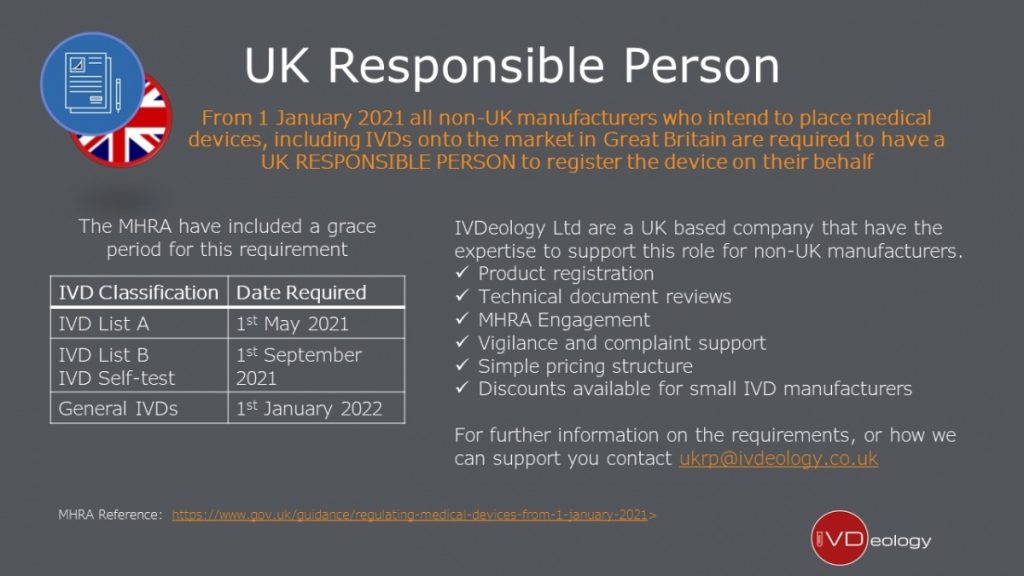
Since 01st January 2021, all non-UK medical device manufacturers (including IVDs) have been required to appoint a UK Responsible Person (UKRP) to act on their behalf in carrying out specific tasks, in order to place their devices on the Great Britain market.
In summary, the UKRP’s responsibilities include the following as a minimum:
Device registration
Technical documentation review
MHRA engagement
Vigilance and complaint support
We are just over 7 months into the requirement and now that 01st May 2021 has come and gone, all Annex II List A IVDs should be registered with the MHRA. Annex II List B and Self-test IVDs have until 01st September 2021 to be registered and General IVDs have until 01st January 2022.
So, what lessons have we learnt so far for IVDs?
Letter of Designation
Non-UK manufacturers must prepare a Letter of Designation (LoD) to appoint their UKRP. This needs to be signed by both parties and is provided to the MHRA as part of device registration.
The device registration process will be a lot smoother if non-UK manufacturers and their designated UKRP ensure the LoD takes into account the following:
1) Manufacturer’s details, especially the name and address, are consistent within the LoD, Declaration of Conformity (DoC), EC certificates (where applicable) and the device registration application;
2) Include an expiry date for the LoD;
3) Attach a list of all IVDs (device name and code) to be registered to the LoD;
When compiling a list of IVDs to be registered, I urge manufacturers to check that device names and any reference codes are consistent with, i.e. appears the same as, other documents such as labels, DoC and EC certificates. The UKRP will use this list to register the devices and getting it right first time will reduce the risk of application rejection.
Manufacturers also need to consider and communicate with their UKRP what device information they want printed on an MHRA Certificate of Free Sales (CFS). Do you just want the device name to be printed, or do you have different models and reference codes that also need to appear on a CFS?
GMDN Codes
Global Medical Device Nomenclature (GMDN) codes are used to name and group medical devices and are required as part of MHRA device registration. Manufacturers need to register for an account on the GMDN website (https://www.gmdnagency.org/) to obtain GMDN codes.
Manufacturers should aim to obtain GMDN codes, for every IVD to be registered, early in the process. Include them in the list of devices to be registered that is provided to the UKRP. Without them, submission of the registration application can be delayed.
As an aside, where manufacturers have more than one device with the same GMDN codes, the UKRP can register the devices using a bulk upload. This saves a lot of time and will speed up the UKRP’s preparation time for the device registration application.
Experience
Finally, manufacturers need to find the right people with the experience to help walk through the process. Device registration is just the beginning, and this includes technical documentation reviews by the UKRP. Finding and appointing a UKRP that is the right fit for a non-UK manufacturer will pave the way for a smoother ride further down the line. This is critically important as we get closer to understanding the new requirements of the UKCA process, where the UKRP will play a key role to providing information back to the manufacturer.
Key points for non-UK IVD manufacturers to consider for appointing their UKRP and MHRA device registration:
For more information on the UKCA/UKRP responsibilities visit our websiteor contact us to find out how we can help you with our UKRP service [email protected]
Quality Management System – three words that bring dread to people new to the industry and in my experience to some people who have been in the industry for years. In the almost 20 years I have worked in the industry I have worked on both sides – the side trying to circumnavigate round the Quality management system (QMS) and the side trying to ensure that it is followed and maintained. But what is it and more importantly why is it needed?
A QMS is defined as a formalised system that documents processes, procedures, and responsibilities for achieving quality policies and objectives. Sounds complicated but what does that really mean?
A QMS is the way you document what you do and how you do it. It identifies the activities required to meet both your customer and regulatory requirements. It includes the documentation that controls the manufacture and release of your product, the controls in place to ensure materials you buy conform to the specification you require, the training completed to allow people to do the job correctly, the instructions on what to do if something goes wrong, how you control updates to documents, to name but a few.
For IVD’s, the industry standard is ISO13485:2016, where manufacturers can achieve a certificate of conformity from a notified body. Certification is an easy way of demonstrating to your customers your commitment to quality and that you have the required controls in place to manufacture a reliable, safe and effective product. However, whilst this is highly recommended, it is not mandatory. Annex I of the IVD Directive states that the manufacturer must reduce risks as far as possible or take adequate protection measures in relation to risks that cannot be eliminated. It is therefore vital that to ensure that you have procedures for controlling the highest risk activities in your manufacturing process.
However, many QMS’s present artificial barriers to the company and therefore people spend an extraordinary amount of time trying to find ways to avoid following it. I have often wondered that if even some of this time had been spent trying to improve the process rather than finding new ingenious ways of trying to avoid it, how much better off the company would have been. It is therefore important that when building your QMS that you try to ensure that it aligns with the existing workflow so it works with the company rather than against it.
So other than a regulatory requirement that you must meet, what are the benefits of the QMS? It gives you a framework for controlling and ultimately improving your processes. It is the way you ensure that the final product is made right first time – helps to prevent mistakes, reduce discards and therefore lowering your production costs. It helps to ensure that you meet your customer requirements and that customer satisfaction is preserved. This helps build confidence in your company and ultimately leads to more sales both from new customers and returning ones.
So rather than consider the QMS as a tick box exercise to enable you to get on the market, if done correctly, a QMS would definitely be an asset to your company and not just a regulatory requirement.
Happy April 1st everyone! It feels we can all take a collective deep breath. We got through lockdown, Brexit came and went (which identified its own problems – but that’s a different blog!) so it feels that we’ve made it! So I celebrate this day by sitting in a sunny spot sipping my freshly brewed coffee, then it hit me – ‘Holy Moley, IVDR is coming!’. For being such an enormous dark shadowy figure looming on the horizon, we lost sight of it in the fog of the events of the last few months. But now the need for preparing for this transition is fully in focus.
We know that (at the time of writing) the IVDR will fully come into force on 26th May 2022. It presents a seismic change in the way IVDs are regulated within the EU. It replaces the aged and slightly creaking IVD Directive with the overall aim to make IVD devices placed on the market safe and effective, but it is a significant uplift on the current regulatory requirements.
Conservative estimates for a transition from the IVDD to the IVDR for manufactures is minimum 12-18 months taking into account the interactions with notified bodies, conformity assessments, technical file sampling, and for class Ds the additional burden of external testing labs and availability of common specifications. The upshot of this is that if you intend to maintain devices on market under the IVDR from May next year, you should be well under way in your transition activities.
From our experience we know there are some common areas that require much focus:
Intended Purpose statements
Use and control of economic operators
Packaging and labelling updates
Performance evaluation
Technical file remediation
Quality Management System updates
Each piece of this jigsaw can take many months to plan, review and implement changes. All this needs to be done before the EU notified body reviews your systems. The resource and time required to do this should not be underestimated so planning and budgeting is essential.
To add further complexity, we are just over a year away from implementation, and we still only have 4 notified bodies designated to the IVDR. While these notified bodies are established and ready to support the industry, it seems to me that this is a very small funnel to put a very large number of devices through to compliance. There will be a time soon where the available notified bodies will not be able to support further customers, either under the IVDD or IVDR framework. The availability of these gate keepers is a real concern and should be keenly watched in the following weeks and months ahead.
We also know that the European Commission is behind on providing the suitable framework for the IVDR to be fully implemented. There are still many unknowns regarding Eudamed and Common Specifications for higher risk devices, just think of the number of Covid-19 devices placed on the market in the last 12 months alone. Without sufficient guidance, strategic planning for transition is more and more challenging.
So where are we going to be in 12 months’ time? Will the IVD industry be ready for the IVDR? This is the million-dollar question. Personally, I think we are far behind where we all thought we would be two years ago. Unless the European Commission considers an extension to the transition process, the industry be facing significant, time critical hurdles. The potential scenario where devices will not be available on the market is a very real risk, and this will have significant implications to the healthcare system.
While there are still many unknowns, and it may be difficult to navigate through the complexities of the IVDR transition, I think it is important to not wait for answers from either the commission or notified bodies. The IVD industry needs to pick a path towards the IVDR and crack on! And don’t pin all your hopes on a delay to the IVDR timeline, as it may never come, and hope is not a strategy!
Under new guidance published on 1 September by the MHRA, from 1 January 2021 all non-UK Medical Device and IVD Manufacturers are required to appoint a UK Responsible Person to place devices on market in Great Britain. IVDeology Ltd can support this role. Contact us for more information.
Last week I was able to rent and watch “Star Wars: The Rise of Skywalker” and take the edge off the ongoing social distancing in our household. If you haven’t seen it (I won’t share any spoilers) it finishes the series off nicely. But it reminded me of the common response when I moved from a Technical role within an IVD industry to my first Regulatory position many years ago…
Oh NO!! You’ve joined the DARK SIDE (Queue dramatic music here!)
The initial move was actually quite a challenging move and I really struggled to change my perspective from being on the other side of the RA line. From a busy lab environment to the quiet office work of Regulatory Affairs, it was a very different type of work and a different series of deliverables, but certainly no less challenging. Very early on I realised that the more you read, and having a thirst for knowledge, the more you develop an understanding of the IVD regulations. The diversity of the day to day challenges was immense, from global trade compliance, product registrations, packaging, animal origin certification, design changes to risk management – I had to cover so much ground throughout the organisation I was working for at the time. It took many months to get a full handle of the roles and responsibilities from the day to day function of a RA professional.
At first it felt like a different world to my old technical roles. But actually, the knowledge and experience that I had developed from manufacturing and technical functions really provided a solid grounding for the new RA role. My technical understanding of the products, and the method of manufacturing was so important to assess the state of the technical submission files and design changes that I would be reviewing as RA. Without this experience I would not been so effective in my role. In addition, I had a good understanding of a non-RA perspective when compliance issues came up. Half the battle of RA is to be able to clearly and objectively relay the key regulatory requirements and expectations in a way that the other person can understand and appreciate. Can you get the key information across in 5 minutes before they just switch off as its “just RA stuff!”.
So all my working life, from jobs in pie factories (for 3 days), warehouses, tourist ferries, sport centres and then IVD companies, has resulted in me turning to the dark side. So on this day I would like to think that in turning into the Regulatory Affairs professional I am , I’ve also been able to bring some of my Jedi skills with me too…. Stay safe in the this period of continued Covid-19 lockdown and above all… May the 4th be with you!!
Me donning my Sith cloak (fleecy dressing gown in these self-iso conditions). 😊
As we speed through 2020 and towards the implementation date for the IVDR, the team here at IVDeology are getting a great level of interest and questions from UK based distributors, importers and authorised representatives about how the change of regulation will impact them. Some have a good relationship with the IVD manufactures and are more informed of the impact on their business, others are still very much in the dark and are getting nervous on what they need to adapt to survive beyond May 2022.
Our aim is to provide clear and simple regulatory advice to the IVD industry, including authorised representatives, importers and distributors. Therefore it is with great pleasure and excitement that today we would like to announce our first workshop presented by IVDeology on the impact of the IVDR on Economic Operators. The 1 day CPD certified course will provide a top level view of the impact of the IVDR using presentations, discussions, working sessions and Q&As with our experts.
The course will be held at the wonderful location of Historic Chatham Dockyard in Kent and lunch will be included.
Spaces are limited so if this would be of interest to you please e-mail us at [email protected]
Covid-19 is starting to have a huge impact on all companies big and small. At IVDeology we are all fit and healthy but have taken the steps to self-isolate and work remotely from home (I am writing this from my kitchen!). While we miss the interaction that being in an office can bring, we are learning how to work more effectively using remote tools. At this point your company may be doing the same thing.
It may be challenging for companies to find suitable remote working activities, especially as many roles within IVD manufacturing cannot be performed working from home. However, with the IVD Regulation coming into force in just over 2 years time this is the perfect time to engage with all functions to consider the impact of the IVDR on your products.
The generation of product Technical Files should be a cross-functional activity that requires a collective effort across the business. Much of this can be done remotely by non-regulatory or quality experts. Here are some questions you could ask yourself:
How does the intended use statement described within the IFU meet the requirements of the Intended Purpose statement required within Annex I and Annex II?
Have you laid out a structure for your technical documentation aligned to Annex II?
Is your performance data well organized, clear and unambiguous? Can all reports be logged and labelled so that they can be easily found?
Is your Risk Management file up to date?
Have you generated or reviewed your Scientific Validity for all your devices?
IVDeology aim to be the UKs leading provider in IVD regulatory and quality services and we have the tools and a number of experts who can support your teams in the assessment and remediation of IVD technical documentation, either in person, or remotely as part of Covid-19 self-isolation!
For further information on what you need to know, and how we can help contact us [email protected]